

What is your money worth in the future

If you spent $100 on something silly (e.g. new phone, lattes, fast food) how much is that really worth in the future. Thirty years from now what could have you purchased?

Assume you put your money in the stock market with an average 12% annual return. Your money is also growing tax free using compound interest.

In 10 years that $100 would be worth $310
In 20 years that $100 would be worth $964
In 30 years that $100 would be worth $2,995
In 40 years that $100 would be worth $9,305
In 50 years that $100 would be worth $28,900

If you want to calculate what $10 would be in the future just move the decimal to the left one digit. To see what $1,000 would be move the decimal to the right one digit and add a zero.

Devaluation of the Dollar and Inflation 🙁

Before we get carried away lets make sure we take into account inflation and the devaluation of the dollar. Using the Bureau of Labor Statatics Calculator we find that the money has much less buying power as it did in the old days. For example:

10 years from now $310 would only be worth $233
20 years from now $964 would only be worth $526
30 years from now $2,995 would only be worth $901
40 years from now $9,305 would only be worth $1,494
50 years from now $28,900 would only be worth $3,855

While it’s next to impossible to predict exactly the rate of inflation in the future these numbers give a ‘ball park’ figure. Using the calculator backwards I entered my compound growth amount in the first box with 2008 as the year. I set the second box back 10, 20, or 50 years. Pressing ‘calculate’ shows what $100 would be worth after inflation adjustments over the select number of years.

Talking about inflation always depresses me. The fact the it could take $28,900 and turn it into $3,855 is just sad. But the good news is that if you grew your investment in a tax sheltered IRA you get to keep every penny of that investment.

Inflation Calculator


Compound Interest Calculator
Tagged with:
 

consumption-vs-income.jpg
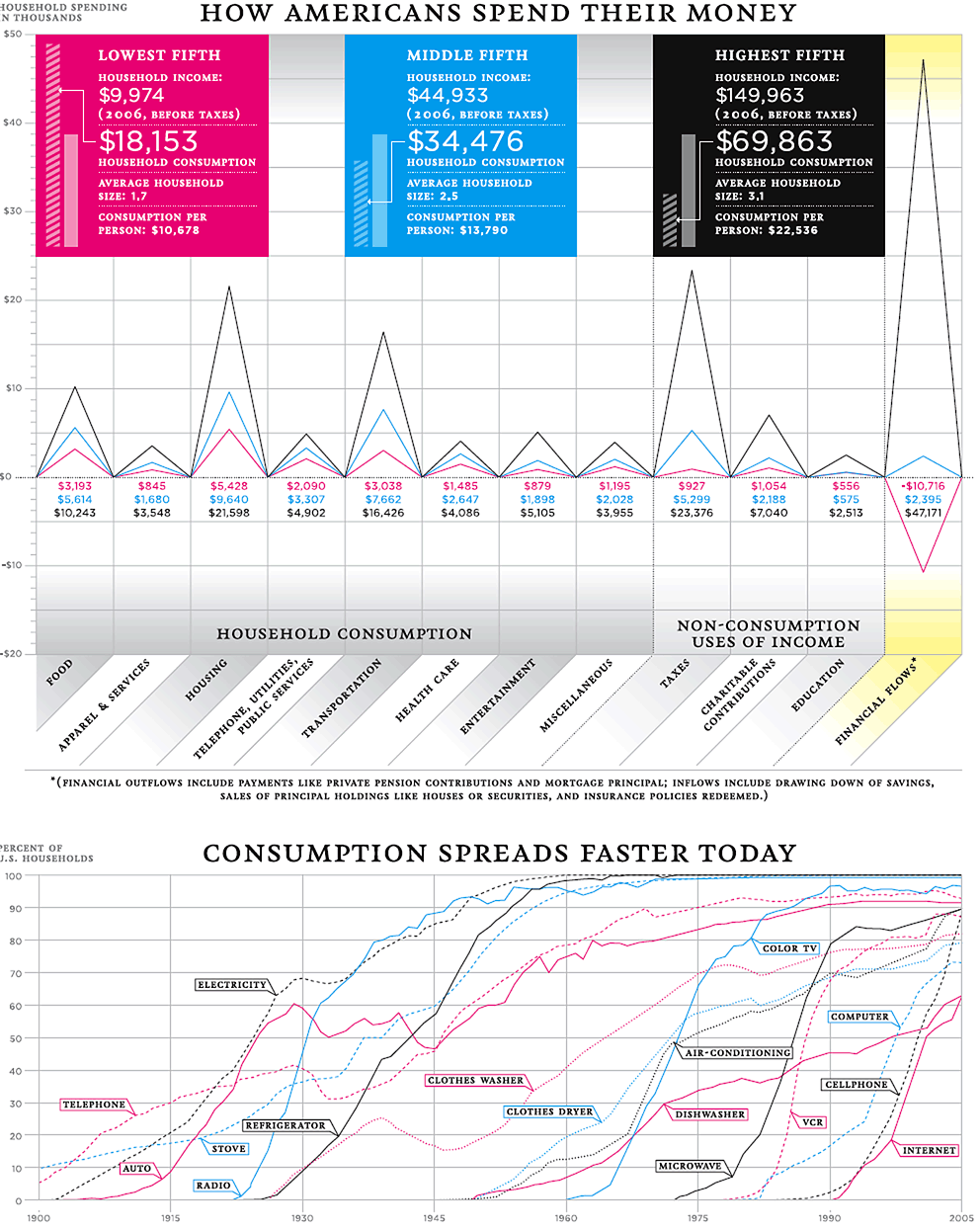
This article by the New York Times explains why ‘consumption’ not ‘income’ is the best indicator of wealth. The article explains that the top fifth makes 15 times more income than the bottom fifth. But when compared using consumption as the criteria of wealth the upper rich only consume four times that of the bottom fifth. The article indicates that new technologies become cheap quicker than in times past. Global trade lowers input costs and maximizes efficiencies for each country involved. With recession looming the author warns that protectionist measures will actually drive up the cost of everyday goods and leave the poor even poorer.

A really cool graph

The article makes an interesting point and the chart they attached is even more interesting. Some of the most interesting observations from the chart are:

  • The rich spend much more on education than the poor do. The poor don’t even register on the chart for their educational spending.
  • The rich spend a considerable amount of their income on taxes and savings. The poor actually have negative savings.
  • New products are only taking 15 years to hit 80% market saturation instead of 50-70 years required in the past.
  • Multiple items per household is much more common. Multiple cars, televisions, computers would be unheard of 50 years ago.
  • The rich donate more of their income to charities than the poor or middle class. Each class donated poor 5.8%, middle class 6.3%, and the rich 10%.


Note:
The problem with this chart is that it doesn’t distinguish age groups. The “poor” in the study make up a large number of retired people. These people are drawing down on past savings and wouldn’t be investing in education, thus skewing the numbers. Even with that consideration many of the observations hold true. The middle class saves much less, spends more on vehicles, are less charitable, and invest less in education than do rich folks. I can’t help but think of the lessons in Rich Dad Poor Dad when I see a study like this.

Tagged with: