
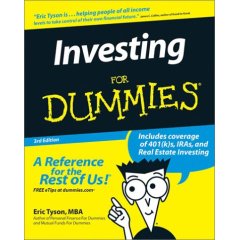

I always get a kick out of these ‘for Dummies’ book titles. If they used another derogatory term instead of ‘dummies ‘do you think they’d sell any books? Some alternative titles might read ‘Investing for complete idiots’ or ‘Investing for the mildly retarded…please stop drooling on the book and pay for it’. Like or hate the title of this book Investing for Dummies it is actually pretty good.
Main Themes & Topics
Mutual Funds
Stock & Bond Investing
Money Market accounts V.S. FDIC insured savings accounts
Real Estate
Entrepreneurial Start-up businesses
T-Bills and Municipal Bonds
Tax Considerations
Surprises
One thing Eric spends a good deal of time on is starting your own business. Most investment books don’t include this as an option. As an entrepreneur at heart I really enjoyed this part of the book. He provides a checklist of 10 characteristic an entrepreneur must have to be successful. While starting your own business is an exciting investment opportunity I think Micheal Gerber’s points on entrepreneurial start-ups should be considered. Investing for Dummies treats all businesses as the same and they just aren’t. You’ll need to read Micheal Gerber’s eMyth Manager book to understand what I’m saying.
Summary
This book is very good at giving a birds-eye-view on the world of investing and doesn’t go into too much depth. This is the book’s strength as well as the book’s weakness. It doesn’t teach you all the terms you’ll need to know in each of the subject. Instead it defines the key concepts and strategic considerations. It gives a rookie investor an idea of what to expect with different investment vehicles. If you’ve saved up some money to invest but don’t know where to start, this is the book for you!